


Please Leave Us A Message
Privacy statement: Your privacy is very important to Us. Our company promises not to disclose your personal information to any external company with out your explicit permission.

Pinghu Kaili New Energy Technology Co., Ltd.
The right technology depends on climate, humidity sensitivity and operating hours — not on which system has the best headline COP. A hot, dry hall with 12-hour shifts is a strong case for evaporative cooling; a battery dry room or a GMP suite is not. This article compares the three routes on capital cost, energy use, humidity behaviour and maintenance burden, then gives a four-question filter that gets you to a shortlist quickly. Kaili builds all three categories in Pinghu, China, so the comparison below reflects real quotations rather than marketing claims.
Evaporative systems move heat by water evaporation, refrigerant systems move it through a compressor cycle, and chilled-water systems move it through a secondary fluid loop. That single difference drives almost every other number in the comparison.
Direct evaporative cooling can approach the wet-bulb temperature. In hot, dry climates the temperature drop is often 10–18°C, with a fraction of the electricity a compressor system needs. Published figures vary widely — some vendors claim 80–90% lower power draw than conventional comfort cooling — so treat the range as a design hint and demand a site calculation. The trade-off is added moisture: in a hall that already fights condensation, an evaporative Air Conditioner can solve temperature while making humidity worse.
Refrigerant equipment cools air directly across an evaporator coil and removes water as condensate. It works in humid climates, holds a stable setpoint and is the default for offices, control rooms and process areas. A packaged unit has modest upfront cost and simple installation, but efficiency falls as ambient temperature climbs and the compressor carries most of the energy bill.
Water-cooled systems produce chilled water that feeds air handlers, fan coils or process jackets. The Industrial Chiller is the core of that loop. It costs more to install — pumps, piping, water treatment and sometimes a cooling tower — but at high running hours it wins on kW per ton and on service life. A well-maintained plant can last 20 years or more, while packaged equipment is commonly replaced after 12–15 years.
| Decision factor | Evaporative | Refrigerant packaged | Chilled-water loop |
| Best climate | Hot and dry | Any, including humid | Any |
| Typical efficiency | Very high — fan and water only | COP roughly 2.5–4.5 | 0.48–0.55 kW/ton at part load |
| Humidity effect | Adds moisture | Removes moisture | Controlled separately |
| Installed cost | Lowest | Medium | Highest |
| Running hours to justify | 1,000–3,000 h/yr | 2,000–6,000 h/yr | Above 4,000 h/yr |
| Maintenance | Pad and water treatment | Filters, coils, charge | Water chemistry, pumps, towers |
✅ Bottom line: Use evaporative cooling for dry, high-airflow spaces, packaged refrigeration for humidity-critical rooms, and a water loop for large continuous loads.
If the product or process has a humidity limit, moisture control becomes the primary system and temperature control becomes secondary. Many factories buy cooling first and discover later that the real problem was water vapour: labels lifting, cartons softening, steel rusting, or powder caking.
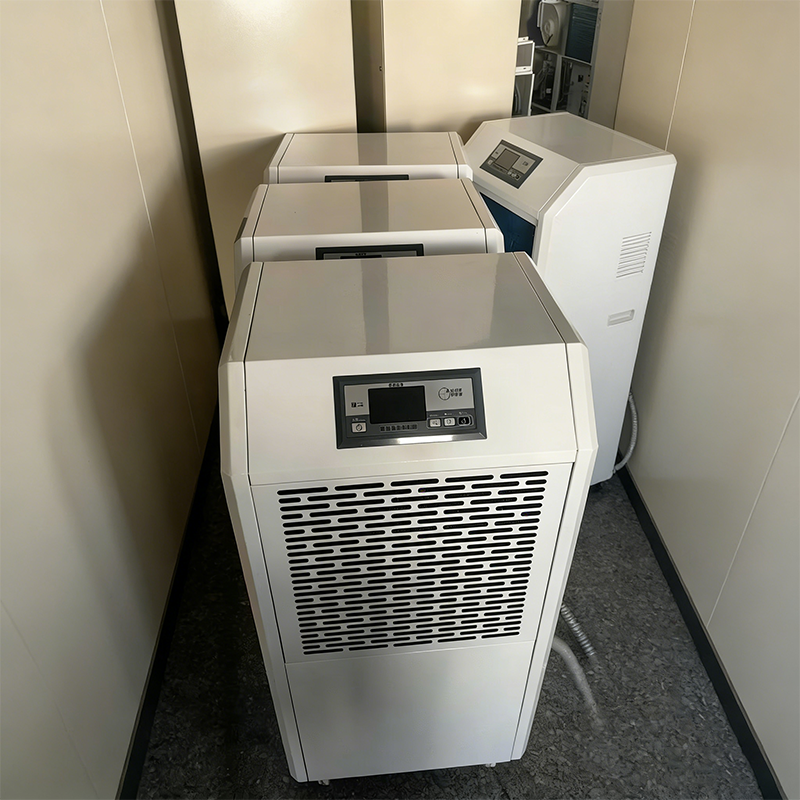
At 25°C and 60% RH a room feels fine; at the same temperature and 80% RH the same room damages goods. Refrigerant equipment reduces humidity only while the coil is cold and the compressor is running. When the sensible load is satisfied, the unit stops dehumidifying — a common reason a space feels cool but stays damp. A dedicated Dehumidifier continues removing water independent of the temperature setpoint, which is why process rooms often need both systems.
Cold environments change the technology choice again. Below roughly 15°C, refrigerant coils frost and spend part of each cycle defrosting. A desiccant rotor adsorbs moisture directly and keeps working at low temperature, at the cost of regeneration energy. A large Industrial Dehumidifier of that type is standard in lithium battery dry rooms, where the target is expressed as dew point rather than RH; the same principle applies to cold storage and unheated warehouses.
Practical combinations that work in the field:
Pinghu Kaili New Energy Technology Co., Ltd. supplies these as matched packages. As a China manufacturer and OEM supplier we can match voltage, refrigerant, control protocol and cabinet finish to a distributor's market, and we publish part-load data so that the comparison is honest at 40–70% load. Kaili engineers also check whether a site's humidity problem is actually an infiltration problem — adding capacity cannot fix a door that stays open.
✅ Bottom line: Choose the moisture strategy first, then pick the cooling technology that supports it; the reverse order produces expensive, damp rooms.
Q: Can evaporative cooling work in a humid coastal city? A: It still moves air and gives a smaller temperature drop, but performance falls sharply. In humid climates a refrigerant or water-loop system is normally the safer specification.
Q: Is a chilled-water system worth the extra investment for a small plant? A: Usually not below roughly 4,000 operating hours per year. For continuous process cooling, the efficiency gain and longer life can repay the premium within five to eight years.
Q: Do you supply private-label systems to distributors? A: Yes. Kaili provides OEM and ODM configurations, custom voltage and frequency, and factory-direct supply for wholesale partners. Send the site data for a proposal.
Send us your ambient design conditions, target temperature and RH, operating hours and electricity tariff. We will return a side-by-side energy and capital comparison for the three routes, plus a recommended layout and a factory-direct quotation. Distributors can request our OEM catalogue and part-load performance curves.
Mobile: +86 13819409755
Email: 411868414@qq.com
Website: www.phkltech.com
Email to this supplier
Privacy statement: Your privacy is very important to Us. Our company promises not to disclose your personal information to any external company with out your explicit permission.
Fill in more information so that we can get in touch with you faster
Privacy statement: Your privacy is very important to Us. Our company promises not to disclose your personal information to any external company with out your explicit permission.